

Paige Geisler
Licensed Insurance Agent
Paige is an assistant agent for State Farm and is licensed to sell property and casualty, health, and life insurance in Virginia. She handles all different types of insurance and financial services and is currently working on a securities and bonds license. Paige has a degree from Radford University in English and is a certified notary.
Articles by Paige Geisler (81)

Life Insurance Industry Trends Survey 2022 - Results
Insurancy's life insurance industry trends survey found consumers cool on insurtech: 77% reject fluctuating premiums tied to physicals, 62% are uneasy about AI in the buying process, only 7% would share DNA data, and 78% still prefer buying from a local agent. Gen Z stands apart, ranking retailers like Costco and Amazon above online agencies.

End of Life: A Grief Support Resource Guide
There is nothing in life harder than the death of a loved one. Grief is real, with both mental and physical symptoms, and even the very worst grief is survivable. This resource guide collects vetted links for coping with grief day to day, recognizing complicated grief, finding support groups, and supporting children and families through specific kinds of loss.

Health Resources for End-of-Life Care
End of life looks different for everyone, which makes planning ahead feel uncertain. This guide collects trusted resources for every stage: elder care and healthy aging, hospice and palliative care, advance directives, locating life insurance policies and filing claims, and grief support for the whole family.

Breast Cancer Statistics - Key Facts and Survival Rates
The American Cancer Society estimates 316,950 new invasive breast cancer cases and 42,170 deaths among US women in 2025. Median age at diagnosis is 62, incidence has risen about 1% per year from 2012 to 2021, and death rates continue a long decline thanks to screening and better treatment.

Buyer Trust and Influence Study 2024 - Key Findings
Insurancy asked nearly 2,400 US respondents about their online browsing and purchasing habits to understand what builds buying trust. The study covers how reviews, social proof, search behavior, and brand reputation shape the modern path to purchase.

COVID-19 and Life Insurance Survey - Consumer Outlook
Insurancy's COVID-19 and life insurance survey of 1,500 people found nearly half already had a policy and about 70% said the pandemic did not change their outlook on coverage. Insurers now ask about COVID-19 in applications, and a positive test can mean a 30-to-60-day waiting period before a new policy is issued.
How Much the Biggest Pharma Companies Make Every Second
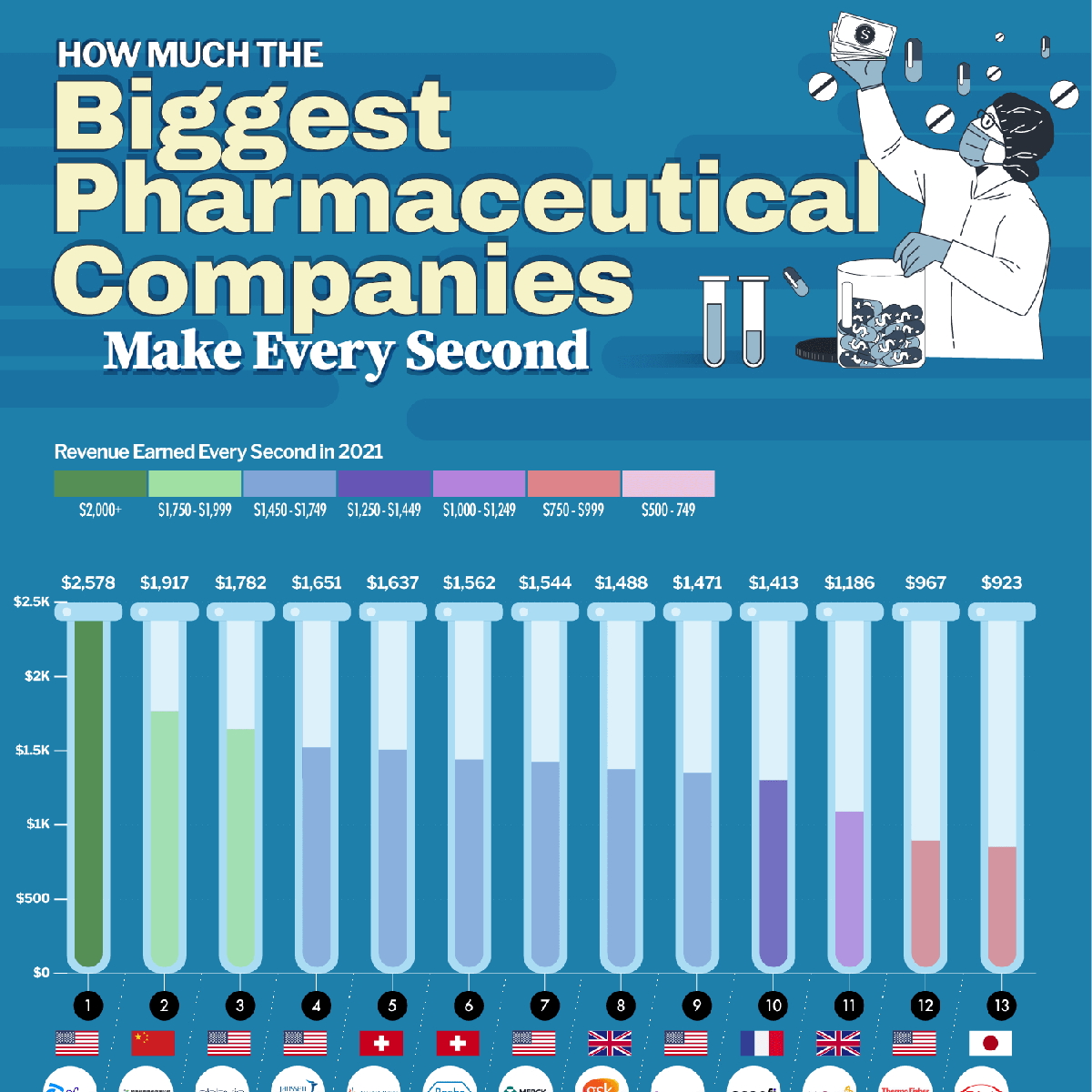
Insurancy broke down the annual revenue of the 25 biggest pharmaceutical companies into revenue per second. Pfizer topped the 2021 ranking at $2,578 earned every second, and the 2024 update shows Johnson & Johnson leading at roughly $2,816 per second based on full-year 2024 reports.

Insurtech Survey - Fitness Trackers and Life Insurance
Insurancy's insurtech survey of roughly 1,000 US respondents found 77% are uncomfortable with life insurance premiums that fluctuate based on yearly physicals, and 59% refuse to wear a fitness tracker that reports to insurers - even for a better rate. Younger respondents were the most resistant, complicating the industry's wearables push.
Life Insurance and COVID-19 Study - 2024 Findings
Insurancy's life insurance and COVID-19 study found 48.2% of respondents own a personal policy, interest in buying coverage rose slightly during the pandemic, and 3 in 4 people do not believe COVID-19 will be treated as a pre-existing condition. Concerns about rising rates were common, making early application the practical takeaway.

Life Insurance Statistics 2026 - US Industry Facts
About 51% of American adults own life insurance according to LIMRA's 2025 Insurance Barometer Study, and ownership has drifted down from 63% in 2011. This report combines Insurancy's own consumer research with industry data on why people buy coverage, how they shop, and which companies write the most premiums.

Life Insurance Consumer Report 2025 - Key Findings
Insurancy's Life Insurance Consumer Report finds Gen X is the age group most likely to own life insurance and Gen Z the least likely, while marriage and children both raise ownership sharply. Notably, 70% of respondents now estimate the cost of life insurance correctly, challenging the long-held industry belief that consumers dramatically overestimate prices.

Online Shopping and E-commerce Statistics 2024 Study
Insurancy surveyed 2,400 US respondents about their online research and purchasing habits. The e-commerce study covers how shoppers use reviews and search, how mobile changes buying behavior, and what ultimately drives online purchases.

What Is Bereavement and End-of-Life Support?
Bereavement is the period of grief and mourning after the death of a loved one. Grief affects everyone differently, from anticipatory grief before a death to complicated grief that lingers. This guide explains the types and manifestations of grief and collects vetted resources for supporting the bereaved - and the end-of-life nurses who care for dying patients.

Investment Trends Study 2025 - Investor Statistics
Insurancy's investment trends study surveys how Americans invest: online apps, cryptocurrency, internet investing, robo-advisors, and the differences in how men and women approach the market.

Does Auto Insurance Follow the Car or the Driver?
Auto insurance generally follows the car, not the driver - if someone borrows your car with permission and crashes, your policy typically pays first. Certain supplemental coverages, like rental car protection and some liability extensions, follow the driver instead. Who pays after an accident depends on fault, policy exclusions, and whether the driver was permitted.

Do You Need Insurance to Register a Car? State Rules
Most states require proof of insurance before you can register a car, and at minimum you will need your state's required liability coverage. A handful of states let you register before buying coverage or check insurance electronically later, but driving uninsured is illegal in every state except New Hampshire.

Do Car Dealerships Offer Temporary Insurance? What to Know
Most major car dealerships can arrange temporary insurance for a new purchase, but you still need proof of coverage before financing or leasing a vehicle off the lot. Existing policies often cover a new car for a 2-to-30-day grace period depending on the state and insurer, and a 30-day temporary term is usually the practical choice while you shop for a long-term policy.

Georgia Commercial Auto Insurance - Requirements and Costs
Georgia commercial auto insurance is required for vehicles used for business purposes, with minimum limits of $25,000 bodily injury per person, $50,000 per accident, and $25,000 property damage. It works like personal auto insurance but is built for business risks, higher limits, and employee drivers.

Cheap Car Insurance in Arizona - Rates by City and Tips
Cheap car insurance in Arizona starts with the state minimum of $25,000 bodily injury per person, $50,000 per accident, and $15,000 property damage - and rates vary noticeably between Phoenix, Tucson, Mesa, Scottsdale, and other cities. Your driving record, credit, vehicle, and ZIP code shape the premium, so comparing quotes city by city is the core money-saver.

Car Insurance in Tucson, AZ - Rates, Minimums, Companies
Tucson drivers must carry Arizona's minimum liability limits of $25,000 bodily injury per person, $50,000 per accident, and $15,000 property damage. As Arizona's second-largest city, with I-10 and I-19 running through it, Tucson generally sees rates below the Phoenix metro - and shopping several quotes is still the surest way to find a cheap policy.

Married vs Single Car Insurance Rates - Why Singles Pay More
Single drivers typically pay more for car insurance than married drivers with identical driving records, because insurers associate marriage with statistically fewer claims. There is no specific married discount - marital status is simply one of many rating factors - and single drivers can close most of the gap by comparing quotes and stacking other discounts.

Car Insurance in Mesa, AZ - Rates, Companies, Discounts
Mesa drivers pay close to the Arizona average of about $844 a year for car insurance and must carry the state's 25/50/15 minimum liability limits. As Arizona's third-largest city, with heavy East Valley commuter traffic on US 60 and Loops 101 and 202, Mesa rewards drivers who compare several quotes and stack good-driver, multi-policy, and vehicle-safety discounts.

Can You Insure a Car You Don't Own? Non-Owner Coverage
You can often insure a car you don't own, though some states require the policyholder to match the name on the title. Where that is the case, a non-owner policy covers your liability while driving borrowed or rented cars, and adding yourself as a listed driver on the owner's policy is usually the simpler fix.

Car Insurance With a Suspended License - How to Get It
You can get car insurance with a suspended license, and you often must - many states require proof of coverage or an SR-22 filing before reinstating your license. The practical route is working with an independent agent who knows which carriers accept suspended-status drivers, and never driving until the suspension is lifted.

Car Insurance in Scottsdale, AZ - Rates and Top Companies
Full coverage car insurance in Scottsdale averages about $1,673 a year, slightly above the Arizona state average of $1,574 - pricier vehicles and busy Loop 101 commuter traffic both play a part. Scottsdale drivers can close the gap by comparing top-rated insurers and choosing coverage deliberately rather than defaulting to the cheapest quote.

Food Truck Insurance - Coverage, Cost, and 5 Top Companies
Food truck insurance bundles commercial auto, general liability, and property protection for your mobile kitchen. Progressive, Nationwide, GEICO, State Farm, and The Hartford all write competitive food truck policies, and costs vary with the truck's value, your location, menu, and coverage level.

Hired and Non-Owned Auto Coverage (HNOA) - What It Covers
Hired and non-owned auto coverage (HNOA) protects your business from liability when employees or contractors drive rented, hired, or personal vehicles for work. It fills the gap left by commercial auto insurance, which only covers vehicles the business owns, and it is essential once employees run errands, deliver, or travel in cars the company does not own.

Car Insurance When Moving to a New State - What to Update
Moving to a new state usually means updating or replacing your car insurance policy, and most states give you 30 to 90 days after the move to do it. Start with a call to your current agent before you move, expect your rate to change with your new ZIP code, and be ready to switch carriers if your insurer is not licensed in the new state.

Collision Auto Insurance - What It Covers and Costs
Collision insurance pays to repair or replace your own car after an accident, regardless of who was at fault. It is optional under state law but required by most lenders and leasing companies, and the average cost inside a full-coverage policy ran roughly $1,080 to $1,350 a year as of 2020. Your deductible decides how much you pay out of pocket before coverage kicks in.

Comprehensive Auto Insurance - Coverage, Cost, Deductibles
Comprehensive auto insurance pays to repair or replace your car when it is damaged by something other than a collision - theft, weather, fire, falling objects, vandalism, or animal strikes. It averages about $194 a year with a typical $500 deductible, and lenders and leasing companies require it even though state law does not.

What Is an Auto Insurance Binder? Proof Before Your Policy
An auto insurance binder is a temporary document that proves you have coverage while your formal policy paperwork is being finalized. It lists the driver, insurer, coverages, premiums, VIN, and policy number, costs nothing beyond the policy itself, and is most often needed when financing a car, at the DMV, or after switching insurers.

Best Car Insurance for Commuters - Mileage and Rates
The best car insurance for commuters is the cheapest policy that still protects you at commuter mileage, because insurers charge more once annual miles climb past pleasure-use caps of roughly 8,000 to 15,000. Every major carrier writes commuter policies, so comparing quotes at your true mileage is what separates a fair rate from an inflated one.

Best Insurance for a Leased Car - Coverage and Gap Rules
The best insurance for a leased car is the lowest-premium policy that satisfies both your state minimums and your leasing company's requirements - typically full coverage, often with gap insurance on top. Leasing itself does not raise the premium; identical coverage costs the same whether the car is leased or owned.

Why Compare Auto Insurance Quotes Online Before You Buy
Comparing auto insurance quotes online is the fastest way to see how much rates vary between companies for the exact same driver - often by hundreds of dollars a year. Online quotes are free, generally accurate if you enter honest information, and comparison tools can pull multiple company rates at once.

Rental Car Insurance - Do You Need It and What It Covers
Rental car insurance covers liability and damage while you drive a rental, but you may not need to buy it at the counter - your personal auto policy often extends to rentals, and many credit cards include complimentary rental coverage. Check both before paying for duplicate protection.

Best Car Insurance for a Bad Driving Record - Your Options
Most insurers will still cover drivers with accidents, tickets, or a DUI - the trade-off is a higher premium for the 3 to 5 years insurers look back on your record. The best policy for a bad driver is the least expensive one that still carries adequate protection, and rates improve at each renewal as violations age off.

Best Car Insurance for 22-Year-Olds - Rates and Discounts
A 22-year-old typically pays $1,700 to $2,700 a year for a stand-alone auto insurance policy, roughly 60 percent of what a 19-year-old pays and closing in on the national average. Cheapest carriers for 22-year-olds nationally are USAA (military only), GEICO, Erie, and State Farm. Continuous coverage, defensive-driving, telematics, and renters bundling discounts can cut premium another 20 percent.

Adjustable Life Insurance - How It Works and Who It Fits
Adjustable life insurance is a form of permanent coverage where you can change the death benefit, premium payments, and cash-value schedule as your finances shift. It offers more flexibility than whole life and can adapt to new dependents, higher income, or a paid-off mortgage, in exchange for closer attention to funding and periodic reviews.

6-Month vs 12-Month Auto Insurance - Which Is Cheaper?
A 6-month auto insurance policy costs about the same per month as a 12-month policy - the real difference is flexibility versus rate lock. A 6-month term lets you re-shop or switch carriers twice a year, while a 12-month term locks your rate for a full year, which helps if you get a ticket or file a claim mid-policy. Full-coverage 12-month premiums for a typical driver run about $1,400 to $2,580.

Arizona Commercial Auto Insurance - Requirements and Rates
Arizona commercial auto insurance covers vehicles used for business purposes and carries the same 25/50/15 minimum liability limits as personal policies, though most businesses need considerably higher limits. Any car, truck, van, or SUV used for business counts as a commercial vehicle, and personal policies typically exclude business-use claims.

Auto Insurance for a Rebuilt Title Car - What to Expect
You can get auto insurance on a car with a rebuilt title, but expect extra steps: most states require an official inspection, and many insurers offer only liability coverage on rebuilt titles. Average premiums run about $2,422 a year for full coverage and $1,244 for liability-only, a bit more than a comparable clean-title car.

Car Insurance Without a License - How to Get Covered
You can get car insurance without a driver's license, usually by listing a licensed household member or caregiver as the primary driver and excluding yourself. Common reasons include owning a car someone else drives, keeping a stored or classic car covered, and protecting a vehicle for a teen or elderly relative.

Best Car Insurance for 16-Year-Olds - Rates and Discounts
The best car insurance for a 16-year-old is almost always to add them as a driver on a parent policy, which typically costs 40 to 60 percent less than a stand-alone policy for the same teen. Top insurers for teens include GEICO, State Farm, Progressive, and USAA (for military families), with good-student and driver-training discounts often stacking to 25 to 30 percent off.
Best Car Insurance for 18-Year-Olds - Cost and Discounts
At 18, most drivers can legally sign their own auto policy, but the best car insurance for an 18-year-old is still typically to stay on a parent policy. A stand-alone policy for an 18-year-old averages about $3,600 to $5,200 a year, while adding an 18-year-old to a parent policy raises the family premium by roughly $1,800 to $2,400. Good-student and telematics discounts cut both by 15 to 25 percent.

Best Car Insurance With Bad Credit - Cheapest Companies
Drivers with bad credit pay significantly more for car insurance - poor credit can add roughly $1,500 a year versus excellent credit - but USAA, Farm Bureau, GEICO, and Nationwide consistently price it cheapest. Five states (California, Hawaii, Massachusetts, Michigan, and Washington) ban credit-based pricing entirely, and improving your score gradually lowers your premium.

Best Car Insurance for 21-Year-Olds - Rates and Discounts
At 21, car insurance rates drop sharply as most carriers move drivers out of the youthful bracket. A 21-year-old typically pays $1,900 to $2,900 a year for a stand-alone policy. Cheapest carriers for 21-year-olds nationally are USAA (military only), GEICO, Erie, and State Farm. Good-student, defensive-driving, telematics, and renters or homeowners bundling discounts can cut premium another 20 to 25 percent.

Best Car Insurance for 20-Year-Olds - Rates and Discounts
A 20-year-old typically pays $2,400 to $3,600 a year for a stand-alone auto policy, or about $1,200 to $1,800 in additional premium if added to a parent policy. Cheapest carriers nationally for 20-year-olds include GEICO, USAA, Erie, and State Farm. Good-student, defensive-driving, telematics, and multi-line (bundling with renters) discounts can stack to 20 to 30 percent off.

Best Car Insurance for 19-Year-Olds - Rates and Savings
A 19-year-old typically pays roughly half what a 16-year-old pays for car insurance, but still 2 to 3 times what a 30-year-old pays. The best carriers for 19-year-olds nationally are GEICO, State Farm, Progressive, and USAA for military families. Good-student, student-away-at-school, and telematics (usage-based) discounts can cut the premium another 15 to 25 percent.

Best Car Insurance for 17-Year-Olds - Cost and Discounts
The best car insurance for a 17-year-old is typically to stay on a parent policy as a listed driver, where the shared premium is roughly half the cost of a stand-alone teen policy. Nationally the cheapest carriers for 17-year-olds are USAA (military only), GEICO, State Farm, and Erie in the states where it operates. Good-student and defensive-driving discounts can cut 15 to 25 percent off the premium.

Life Insurance for Young Adults - Why Buying Early Wins
Life insurance is cheapest when you are young and healthy, and the rate you lock in lasts the whole term. Term life delivers the most coverage per dollar for young families, whole life starts building cash value early, and no medical exam policies make applying fast. Waiting only raises the price of the same coverage.

What Is Supplemental Life Insurance? How It Works
Supplemental life insurance is extra coverage added on top of a basic policy, most often through your employer. Basic group plans cover a fixed amount or salary multiple, and supplemental coverage raises that limit for an extra premium. It is convenient, but not always portable, which is why many people pair it with an individual policy they own.

General Liability Insurance for Small Business - Coverage
General liability (GL) insurance is the foundation policy for small businesses: it pays for third-party bodily injury, damage to other people's property, and personal or advertising injury claims, including the legal defense costs that come with them. It does not cover your own property, your employees' injuries, or professional mistakes, which need property, workers comp, and E&O policies respectively.

Professional Liability Insurance (E&O) - What It Covers
Professional liability insurance, also called errors and omissions (E&O) coverage, protects service providers when a client claims your work was negligent, wrong, or incomplete and cost them money. It covers legal defense and settlements for professional mistakes, the exact claims general liability excludes, and it is standard for consultants, agents, accountants, designers, and anyone paid for advice or expertise.

Business Overhead Expense (BOE) Insurance - How It Works
Business overhead expense (BOE) insurance reimburses your business's fixed costs, rent, payroll, utilities, insurance, and loan payments, if a disability keeps you from working. It keeps the lights on so the business survives your recovery. BOE complements, not replaces, individual disability income insurance: BOE pays the business's bills while disability income replaces your personal paycheck.

Do LLCs Need Business Insurance? Why the Shield Falls Short
Forming an LLC protects your personal assets from business debts, but it does nothing to protect the business itself. A lawsuit, fire, or injured employee can still wipe out everything the LLC owns. That is why LLCs still carry general liability, commercial property, and workers compensation coverage, and why courts can pierce the veil of an underinsured LLC.

Does Business Insurance Cover Theft? Property vs Crime
Business insurance does cover theft, but which policy pays depends on who stole what. Commercial property insurance covers theft of equipment and inventory by outsiders, usually with signs of forced entry. Employee theft, embezzlement, and stolen cash need commercial crime (fidelity) coverage, and stolen customer data falls to cyber insurance.

How Is Workers Comp Calculated? Premiums and Benefits
Workers compensation math runs on two formulas. Premiums are calculated from payroll (per $100), industry class codes, and an experience modifier reflecting your claims history. Benefits paid to injured workers are a state-set percentage of their average weekly wage, commonly about two-thirds, subject to state maximums and time limits.

How Much Is Commercial Auto Insurance? Cost Factors
Commercial auto insurance pricing is driven by what you drive, who drives it, and what you haul: vehicle type and value, driver records, coverage limits, radius of operation, and industry all move the number. Businesses with clean drivers and light vehicles pay far less than those running heavy trucks, and higher liability limits required by contracts raise premiums.

How to Use Life Insurance While Alive - Living Benefits
Several kinds of life insurance pay benefits while you are alive. Permanent policies build cash value you can borrow against, withdraw, or surrender, and many policies offer living benefit riders that accelerate the death benefit after a serious diagnosis. The tradeoff: money used while living typically reduces what your beneficiaries receive.

Workers Compensation Insurance Guide - Costs and Coverage
Workers compensation insurance pays medical bills, lost wages, and rehabilitation costs when an employee is injured or made ill by their job, and it protects the employer from most injury lawsuits in return. Nearly every state requires coverage once you hire employees, benefit formulas vary by state, and premiums are driven by payroll, class codes, and your claims history.

Is Business Insurance Tax Deductible? IRS Rules Explained
Business insurance premiums are generally tax deductible because the IRS treats them as ordinary and necessary business expenses. General liability, commercial property, workers comp, commercial auto, professional liability, and cyber premiums all typically qualify. The notable exceptions: life insurance where the business is the beneficiary, and certain self-insurance reserves. Confirm specifics with your tax professional.

Employers Liability vs Workers Comp - What's the Difference
They travel together but do different jobs. Workers compensation (Part One of the policy) pays injured employees' medical bills and lost wages regardless of fault. Employer's liability insurance (Part Two) defends the business when an employee sues anyway, alleging negligence outside the no-fault system, covering legal defense, settlements, and judgments.

Is Workers Comp Taxable? IRS Rules for Benefits and Wages
Workers compensation benefits are generally not taxable at the federal or state level: IRS Publication 525 excludes amounts received under workers compensation acts for occupational injury or sickness. The main exception arises when benefits offset Social Security disability payments, making a portion effectively taxable. For employers, premiums are a deductible business expense.

Business Personal Property Insurance - What BPP Covers
Business personal property (BPP) insurance covers the contents of your business: equipment, inventory, furniture, fixtures, tools, and supplies, against fire, theft, vandalism, and other covered perils. It is the "stuff" half of commercial property coverage, distinct from the building itself, and it is typically bundled inside a business owners policy (BOP).

Hazard Insurance for Business - What It Is and Who Needs It
Hazard insurance for business is another name for the commercial property coverage that protects your buildings and equipment against fire, storms, vandalism, and other named perils. The term shows up most often in lending: SBA and conventional lenders require proof of hazard insurance on business assets pledged as collateral before funding a loan.

15 Year Term Life Insurance: Rates and Best Carriers
15-year term life insurance locks your premium and death benefit for 15 years. It is the right fit for buyers who need coverage for a fixed obligation that ends in roughly 15 years (a 15-year mortgage, the remaining years a young child is at home) and who want the lowest possible monthly cost. Premiums typically run 20 to 40 percent below a comparable 20-year term policy.

20 Year Term Life Insurance: Rates and Best Carriers
20-year term life insurance is the most popular term length in the United States because the 20-year horizon matches the years most working-age parents need to replace their income while children grow up or a mortgage is paid down. Rates are locked at issue for the full 20 years and the policy can be converted to permanent coverage in most cases without a new medical exam. A healthy 35-year-old can typically lock $500,000 of 20-year term for roughly $20 to $26 a month with a top-rated carrier.

30 Year Term Life Insurance: Best Rates and Carriers
30-year term life insurance is the longest standard level-term length offered in the United States and locks your premium for a full 30 years. It is the right choice for young parents, homeowners with a 30-year mortgage, and any buyer who wants the longest available rate-lock without committing to permanent insurance. A healthy 30-year-old non-smoker can typically buy $500,000 of 30-year term for roughly $24 to $32 a month with a top-rated carrier.

40 Year Term Life Insurance: Rates and Best Carriers
40-year term life insurance is the longest level-term policy available in the United States and locks your premium and death benefit for a full 40 years. It is only offered by a handful of A-rated carriers (Banner Life, Pacific Life, and Protective) and the maximum issue age is typically 45. 40-year term is the right choice for buyers in their 20s or early 30s who want the absolute longest rate lock available without committing to permanent insurance, or for buyers who want term coverage that reaches into traditional retirement age.

Convertible Term Life Insurance: How Conversion Works
Convertible term life insurance is a term policy that includes a conversion option allowing the policyholder to exchange the term policy for a permanent (whole or universal life) policy without a new medical exam. The conversion preserves the original health class even if the policyholder has developed a serious health condition since the original issue. This makes the conversion option one of the most valuable provisions in any term policy and is a deciding factor when comparing carriers.

Can You Borrow From a Life Insurance Policy? How Policy Loans Work
Permanent life insurance policies (whole life, universal life, indexed universal life, variable universal life) build cash value over time and most carriers let policyholders borrow against up to 90 percent of that accumulated cash value at the policys loan rate. Term life insurance has no cash value and cannot be borrowed against. This guide walks through how policy loans work, the loan rate (typically 4 to 8 percent), tax treatment, the 90 percent cap, and the most common policy-loan trap - what happens when the loan balance plus interest exceeds the cash value and the policy lapses.

How to Read Your Life Insurance Policy (in Plain English)
A life insurance policy is a 30 to 60 page legal contract that most policyholders never actually read. This guide walks through every section in plain English so you know exactly what you bought, what your beneficiary will receive, what could void the policy, and what options you have for converting, borrowing against, or changing the policy down the road.

Medicare Guide
Medicare is federal health insurance for U.S. adults age 65+ and certain qualifying disabled individuals. Original Medicare has four parts: Part A (hospital), Part B (outpatient), Part C (Medicare Advantage), and Part D (prescription drugs). Medigap supplements (Plans A through N) fill coverage gaps in Parts A and B.

Health Insurance Guide
Health insurance is a contract that pays a portion of your medical care, prescription drugs, and preventive services in exchange for monthly premiums. Most Americans get coverage through employers, the federal health insurance marketplace (Healthcare.gov), Medicaid, Medicare, or directly from carriers.

Disability Insurance Guide
Disability insurance replaces a portion of your income (typically 50 to 70 percent) if you cannot work due to a covered illness or injury. According to the Social Security Administration, about 1 in 4 workers will experience a disabling event before retirement age. Without coverage, the financial consequences are often catastrophic.

Is Long-Term Disability Insurance Worth It?
Long-term disability insurance can provide a financial cushion in case an illness or injury keeps you out of work for an extended time. However, there are a few things to keep in mind before deciding on a long-term disability insurance policy.

What Is Group Disability Insurance?
Any time you're unable to work for an extended period due to a health condition, it's called a disability.

What Is a Guaranteed Renewable Disability Insurance Policy?
A disability insurance policy can give you the peace of mind of knowing you'll continue to receive a paycheck if you become disabled and cannot work for a long period of time.

Can You Get Disability Insurance If You Are Self-Employed?
Self-employment is an exciting way to earn a living as it allows you to be your own boss and build your own business. However, self-employment can also be risky. You're responsible for obtaining your insurance, paying your taxes, and saving for retirement on your own.

Medicare Eligibility: When Am I Eligible For Medicare?
Individuals are eligible for Medicare when they reach the age of 65, are diagnosed with a severe medical condition, and/or receive Social Security benefits.

Medicare vs. Medicaid: What Is the Difference?
Medicare is a federally funded program that provides healthcare coverage for people over 65 and those who have severe disabilities. Medicaid is a federal and state program intended to provide healthcare for low-income individuals and families.