


Insurancy

Funding a Buy-Sell Agreement with Life Insurance - Guide

A buy-sell agreement is a contract that fixes what happens to an owner's share of the business at death, and life insurance is the standard way to fund it: the policy delivers the exact cash needed to buy out the deceased owner's stake the moment it is needed. The two classic structures are cross-purchase, where owners insure each other, and entity purchase, where the business owns the policies.

Funding a Buy-Sell Agreement with Life Insurance - Guide
Brian Greenberg

Written by Brian Greenberg

CEO / Founder & Licensed Insurance Agent

Grant Desselle

Reviewed by Grant Desselle

Licensed Insurance Agent

Last updated: July 2026 | 4 min read

Buy-sell agreement life insurance at a glance

  • A buy-sell agreement is a legally binding contract between business co-owners.
  • Life insurance funding helps provide cash to buy a deceased owner’s business interest.
  • Common structures include cross-purchase plans, entity redemption plans, and hybrid plans.
  • Life insurance proceeds are typically paid quickly and usually free from income tax.
  • Premiums used to fund a buy-sell agreement are not tax deductible.

Quick answer

A buy-sell agreement funded with life insurance guarantees the money to buy out a deceased owner's share will exist the moment it is needed. In a cross-purchase plan, each owner buys a policy on the others; in an entity purchase plan, the business owns one policy per owner. Either way, surviving owners keep control, and the family receives fair value in cash instead of an ownership stake.

What are The benefits of a Buy-Sell Agreement funded by life insurance?

With a buy-sell agreement that is funded by life insurance, the company or the individual co-owners buy life insurance policies on the lives of each co-owner. Thus, if you died, the company or the co-owners would receive the death benefits from the insurance policies on your life.

What is a Buy-Sell Agreement With Life Insurance?

A buy-sell agreement is a legally binding agreement between the co-owners of a business. It is sometimes referred to as a buyout agreement.

A buy-sell agreement governs the situation if a co-owner dies, is forced to leave the business, or simply chooses to leave the business. It serves as a kind of prenuptial agreement between the business partners and/or shareholders of a company, sometimes called a “business will.”

Buy-Sell agreement explained

How to Fund a Buy-Sell Agreement With Life Insurance?

With a buy-sell agreement that is funded by life insurance, the company or the individual co-owners buy life insurance policies on the lives of each co-owner.

Thus, if you died, the company or the co-owners would receive the death benefits from the insurance policies on your life.

Plus, your family would get a sum of cash as payment for your interest in the business. This provides financial support for them after your death and it also provides stability for the company.
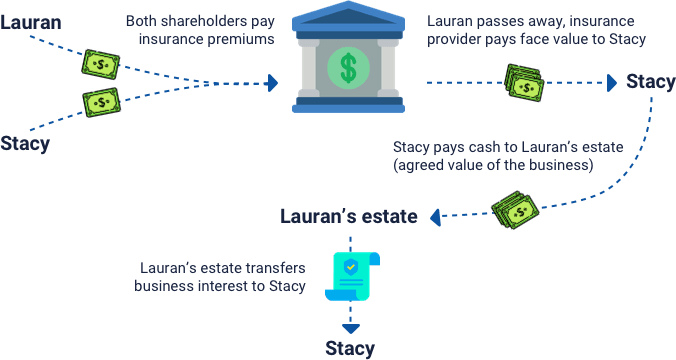
Buy-Sell agreement funded by life insurance

What are the Types of Buy-Sell Agreements?

Buy-sell agreements can take different forms, but the two typical structures are cross-purchase plans and entity redemption plans, with a hybrid version also available as a third possible option.

Cross Purchase Plan

In a cross purchase plan, each owner purchases a life insurance policy on the other owner or owners. Each owner pays the annual premiums on the policy they own and each is the beneficiary of the policy. When an owner dies, the surviving owners use the death benefit to purchase the deceased owner’s share of the business. If there are a large number of owners of the business, multiple policies must be purchased by each owner.

Example
In the following Cross Purchase Plan example, the business is valued at 2 million dollars, and has 2 owners, Lauran and Ted. Each owner holds 50% of the company.
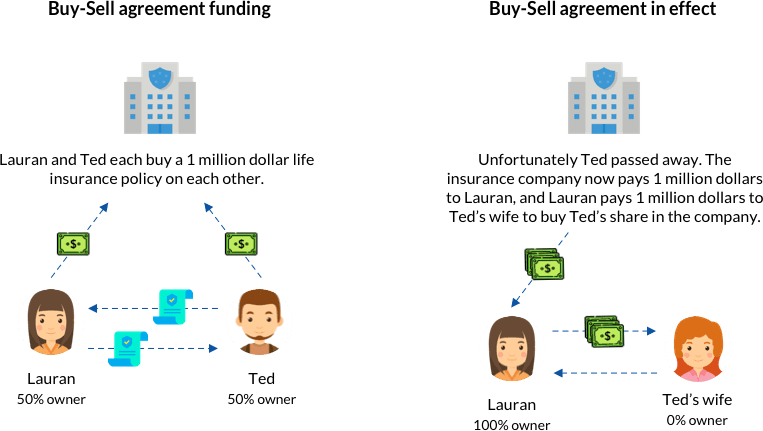

Example of a Cross Purchase Buy-Sell agreement plan funded by life insurance

Entity Redemption Plan

In an entity redemption plan, each owner has an arrangement with the business for the sale of their respective interests to the business. The business purchases separate life insurance policies on the lives of the owners. The business pays the premiums. And the business is the owner and beneficiary of the policy. When an owner dies, his or her share of company stock will pass to his or her heirs or estate, and the company may purchase them with the proceeds from the life insurance policy.

Example
In the following Entity Redemption Plan example, the business is valued at 3 million dollars, and has 3 owners, Stacy, Lauran and Ted. Each owner holds 33% of the company.
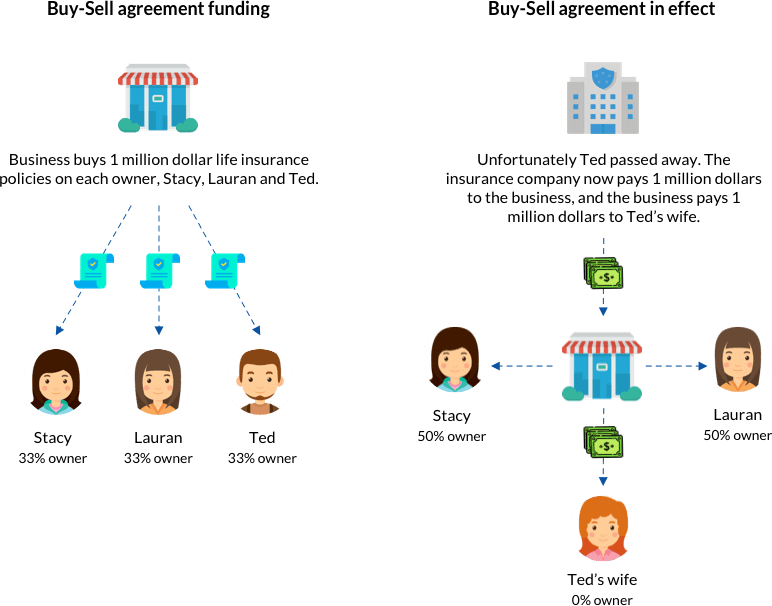

Example of an Entity Redemption Buy-Sell agreement plan funded by life insurance

Hybrid Plan

A hybrid plan, as you might have guessed, combines the first two types of buy-sell agreements: cross purchase and entity redemption. Typically, the owner is required to offer his or her interest to the entity. If the entity declines or cannot make the purchase, however, other co-owners or partners can purchase the shares. This type of arrangement may also allow certain employees, like longtime company officials, to purchase the interest.

Example
In the following Hybrid Plan example, the business is valued at 1 million dollars, and has 2 owners, Lauran and Ted. Each owner holds 50% of the company.


Example of a Hybrid Buy-Sell agreement plan funded by life insurance

Potential Benefits

No matter what kind of business you are involved in, a corporation, a partnership, an LLC, or even a proprietorship, you should strongly consider a buy-sell agreement.

Business specialists and financial planners often recommend life insurance to ensure that a buy-sell agreement is funded properly, guaranteeing that there will be money available should the buy-sell event become a reality.

Plus, the proceeds are usually paid quickly after your death. And if sufficient cash values are available within the policies, the funds can be accessed to purchase your interest in the business if you retire or become disabled. Additionally, the life insurance policy proceeds are typically free from income tax regardless of who owns the policy.

Tax Considerations

There are several tax considerations that should be made when funding a buy-sell agreement with life insurance. As previously mentioned, the death proceeds are free from income tax. If the business is a C corporation, however, the death proceeds may be subject to the alternative minimum tax (AMT).

There are other tax considerations:

  • The premiums used to fund a buy-sell agreement are not tax deductible.
  • The payment of premiums made by a business, where the shareholder or the owner is the insured, are not considered taxable income.
  • In a cross purchase agreement, the cash value of the policies owned by the deceased on the other shareholder’s lives is considered to be in the deceased’s estate. The policies owned by the other shareholder’s on the deceased’s life are not considered in the decedent’s estate, though.

Consult with your legal or tax advisor for answers to specific tax questions regarding a buy-sell agreement.

Take Care of Your Business and Your Family

A buy-sell agreement funded with life insurance will give you the confidence that your business and your family will be taken care of in your absence. Plus, the cost is small compared to the benefits.

Get a Buy-Sell Agreement Funded by Life Insurance

A buy-sell agreement funded with life insurance will give you the confidence that your business and your family will be taken care of in your absence. Plus, the cost is small compared to the benefits.

Below is a list of companies that provide policies for buy-sell agreements.

Ready to shop for life insurance? Start here

Frequently asked questions

What is a buy-sell agreement with life insurance?+

A buy-sell agreement is a legally binding agreement between business co-owners, sometimes called a buyout agreement or a business will. When funded by life insurance, the company or co-owners buy policies on each owner’s life so death benefits can help complete the buyout.

How does life insurance fund a buy-sell agreement?+

The company or the individual co-owners buy life insurance policies on the lives of each co-owner. If an owner dies, the company or co-owners receive the death benefits. The owner’s family can receive cash as payment for the owner’s interest in the business, supporting them and stabilizing the company.

What is a cross-purchase buy-sell plan?+

In a cross-purchase plan, each owner buys life insurance on the other owner or owners, pays the premiums on the policy they own, and names themselves as beneficiary. When an owner dies, surviving owners use the death benefit to purchase the deceased owner’s share of the business. With many owners, multiple policies are needed.

What is an entity redemption buy-sell plan?+

In an entity redemption plan, each owner has an arrangement to sell their interest back to the business. The business buys separate life insurance policies on the owners, pays the premiums, and is both owner and beneficiary. When an owner dies, shares pass to heirs or the estate, and the company may buy them using policy proceeds.

What is a hybrid buy-sell plan?+

A hybrid plan combines cross-purchase and entity redemption approaches. The owner generally must offer their interest to the business first. If the business declines or cannot purchase the interest, other co-owners can buy the shares, and certain employees such as longtime company officials may also be allowed to purchase the interest.

What are the potential benefits of funding a buy-sell agreement with life insurance?+

Life insurance can help ensure a buy-sell agreement is funded properly, so money is available if a buy-sell event occurs. Proceeds are usually paid quickly after death. If sufficient cash values are available, funds can also be accessed to purchase an owner’s interest if the owner retires or becomes disabled.

What tax considerations apply to buy-sell life insurance?+

Death proceeds are typically free from income tax regardless of who owns the policy, but in a C corporation they may be subject to the alternative minimum tax. Premiums used to fund the agreement are not tax deductible. In a cross-purchase agreement, certain cash values may be included in the deceased’s estate, while policies on the deceased owned by others are not.

About the authors

Brian Greenberg

Written by

Brian GreenbergCEO / Founder & Licensed Insurance Agent

Brian is the founder and CEO of Insurancy and carries Life, Health, and Property & Casualty licenses in all 50 U.S. states. Since 2013, Brian has been a member of Million Dollar Round Table, a designation for the top 1% of financial advisors worldwide. Brian has been featured in Yahoo! Finance, Money.com, Entrepreneur.com, Life Happens, Forbes, MSN, and Good Financial Cents. Brian’s goal is to show customers the best products, the quickest answers to their questions, and provide expert advice.

Grant Desselle

Reviewed by

Grant DesselleLicensed Insurance Agent

Grant's past experience includes work as a licensed sales agent for Hagerty Insurance. He has reviewed thousands of existing auto policies across the nation and issued hundreds of new ones on everything ranging from classic cars undergoing restoration to modern exotics and motorcycles.

30-second quiz

Find your best life insurance type

Answer a few quick questions and get matched with the right kind of policy.

Take the quiz

Full assessment

Get your complete coverage plan

How much coverage you need, which type fits, and what you should pay.

Start the assessment

Keep reading

Related articles

Are Life Insurance Premiums a Deductible Business Expense?Life Insurance

Are Life Insurance Premiums a Deductible Business Expense?

Life insurance premiums are generally not a deductible business expense when the business is a direct or indirect beneficiary, which covers key person coverage and policies backing buy-sell agreements. The main exception is employer-paid group term life for employees: premiums are deductible, and the first $50,000 of coverage per employee is also excluded from the employee's income.

Brian GreenbergUpdated Jul 2026

Imputed Income and Life Insurance - The $50,000 GTL RuleLife Insurance

Imputed Income and Life Insurance - The $50,000 GTL Rule

Imputed income is the taxable value of employer-paid group term life insurance above $50,000 of coverage. The IRS sets the value using its Table I uniform premium rates based on your age, and the amount appears on your W-2 (Box 12, Code C) and is subject to Social Security and Medicare taxes. The first $50,000 of employer-paid coverage stays tax free.

Brian GreenbergUpdated Jul 2026

Life Insurance Dividends - How They Work and Your OptionsLife Insurance

Life Insurance Dividends - How They Work and Your Options

Life insurance dividends are a share of a mutual insurer's favorable results paid to participating whole life policyholders. Dividends are not guaranteed, but carriers like MassMutual, Penn Mutual, Guardian, and Foresters have long track records of paying them. Policyholders choose among five uses: take cash, reduce premiums, leave them to accumulate at interest, repay policy loans, or buy paid-up additions that compound coverage and cash value.

Brian GreenbergUpdated Jul 2026

Get the most accurate rates in 2 minutes or less

Making a financial decision doesn’t have to be stressful. See what you qualify for by answering some health questions.

Get a Free Quote