


Quick answer
USAA, Farm Bureau, GEICO, and Nationwide offer some of the cheapest car insurance for drivers with bad credit. Poor credit can add roughly $1,500 a year to a premium versus excellent credit, because insurers link credit history to claim frequency. California, Hawaii, Massachusetts, Michigan, and Washington ban credit-based pricing entirely, and your rate can fall as your score improves.
Bad credit can be a burden. It is used to gauge your financial capability and responsibility. Hence, it affects many aspects of our lives, including car insurance.
If you are a driver with a poor credit score, expect to pay more for auto insurance. This does not mean that lenders are being unfair. Instead, they are trying to be safe given your financial history’s risks.
The Cheapest Car Insurance Companies for Drivers With Bad Credit
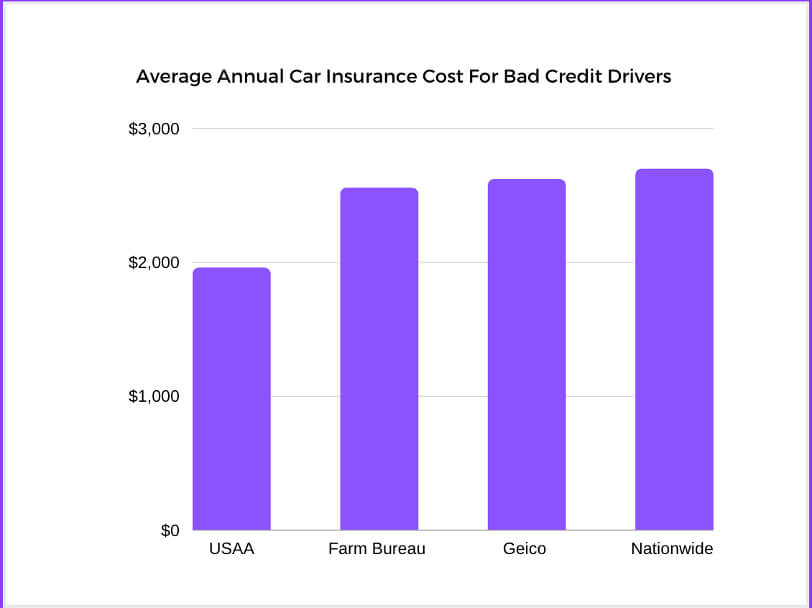
Based on our analysis, USAA, Farm Bureau, Geico, and Nationwide are four companies with the cheapest car insurance premiums for people with bad credit. The table below summarizes the annual rate from each of these providers.
For reference, when we say bad credit, it refers to a credit score that ranges from 300 to 579. Our analysis showed that you can pay a premium up to 70% higher than those with average credit. Nonetheless, the specific amount will depend on other factors, such as the state where you live and driving records, among other things.
- USAA
The United Services Automobile Association offers an average annual premium of $1,950 for drivers with bad credit. This is a jump from its rate for drivers with average credit, which is $1,150 annually. Take note, however, that USAA is not available for everyone. It is exclusive to the members of the military and their families.
- Farm Bureau
Despite its name, Farm Bureau is open to everyone, even those with bad credit, not just farmers. With a poor credit score, expect your car insurance to pay an annual premium of $2,550. Meanwhile, those with an average credit rating will likely pay only $1,575. - Geico
Since 1936, Geico has been providing insurance services in the United States. It offers one of the cheapest annual premiums for drivers with bad credit, approximately $2,600, compared to those with average credit scores, who should expect to pay $1,900 in annual premiums. - Nationwide
Another popular insurance provider in the United States, Nationwide has an average annual premium of $2,700 for drivers with bad credit, compared to the $2,100 annual premium for drivers with an average credit score. This is the smallest difference based on the insurance companies’ credit score.
How to Buy the Best Car Insurance With Poor Credit
If you have bad credit, the best way to buy car insurance is to shop around. Do not be in a rush to find the right policy. The first company you find may give you high premiums, but do not give up.
The best thing that you can do is to go online and look for a car insurance comparison website. For instance, an online comparison tool allows a comparison of up to 15 carriers, providing a snapshot of the possibilities worth considering.
Also, to get the best deals on car insurance, consider all the possible deductibles to bring down the premium. It might also be a good idea to get your home and car insurance from the same company, which might make you eligible for a discount.
Car Insurance Costs By Credit Score
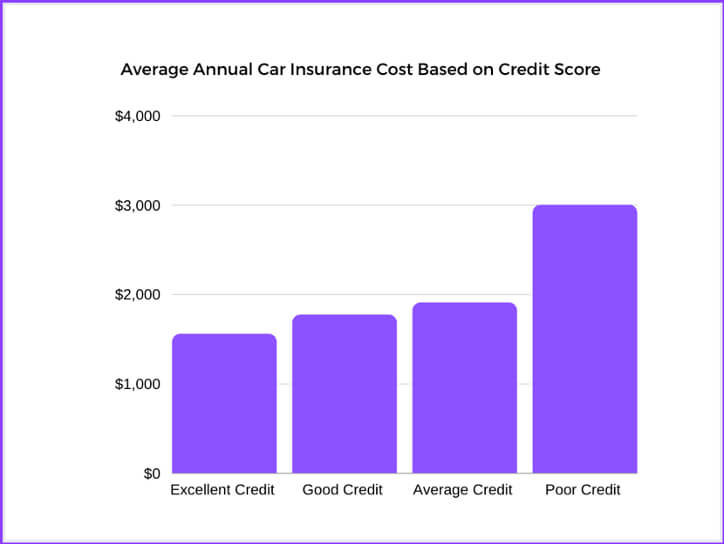
As you can see in the table below, there is a slight difference in the cost of car insurance if you have Excellent Credit ($1,550, Good Credit ($1,770), and Average Credit ($1,900). The biggest difference, however, is when it comes to Poor Credit, wherein the premium for car insurance jumps to $3,000. That is up to 50% higher compared to the rate for drivers with Excellent Credit.
Why Does Credit Score Impact Car Insurance Premiums?
In one study by the Federal Trade Commission, the researchers have proven the correlation between a driver’s credit score and the cost and frequency of car insurance claims. With this, insurance companies perceive drivers with bad credit as higher-risk individuals. Since they are likely to file a claim, their premiums are higher.
Tips to Lower Your Rates With if You Don’t Have Good Credit
Bad credit does not necessarily have to translate to an excessive premium. With a proactive approach, you can lower your car insurance rates. Below are some of the best things to do:
- Start by reviewing your credit report before applying for car insurance. There may be discrepancies or misrepresentations. If you see any errors, work towards fixing them immediately. Do not hesitate to ask the insurer for possible discounts. One of the best things to do is to bundle auto insurance with home insurance. Paying in full can also make you eligible for a lower insurance rate.
- Show that you are a responsible driver. Having bad credit does not mean that you are negligent. If you prove you are a good driver, the insurer can perceive you as a lower-risk individual, lowering your premium.
- Modify the coverage of your car insurance. Learn how to prioritize. Reducing unnecessary coverage and raising your deductibles will make the premium more practical for bad credit drivers.
- Rethink the type of vehicle that you are driving. The more high-end your car is, the more the insurance will cost. Hence, having a more practical car might be a good idea if you have bad credit.
- Get multiple quotes and compare auto insurance quotes online. Do not be devastated after the first quote that you receive. It is best to compare three to five insurers and find one with rates that work best for your needs.
In What States Is It Illegal for Car Insurance Companies to Use Credit Scores?
California, Hawaii, Massachusetts, Michigan, and Washington all ban the use of credit scores in determining an individual’s car insurance premium. Instead, they focus on driving records and other factors beyond a person’s credit standing.
Will My Rates Go Down if My Credit Score Improves?
Your car insurance rates can decrease if you improve your credit score. However, take note that it does not happen overnight. Credit reporting bureaus can update your score on every request, provided that there has been a change in the factors affecting your report. It can take several months or even years, so you must be patient.
Does Applying for Auto Insurance Affect My Credit Rating?
No, applying for auto insurance has no impact on your credit rating. Even if you apply to multiple insurers to compare quotes and find one that is most suitable for you, it does not impact your credit score. Also, car insurers do not report to credit bureaus, so your premium payments will not appear on a credit report.
Do Any Major Insurance Companies Not Use Credit Scores?
Unfortunately, most major car insurance companies use credit standings to evaluate premiums. There are only very few that won’t, but most of them are uncommon and local, such as Dillo in Texas and Cure Auto Insurance in Pennsylvania and New Jersey.
The only instance where major car companies won’t look at your credit is when you are from a state that does not allow using credit reports for insurance.
Do Usage-Based Car Insurance Policies Use Credit Scores?
It depends. Most of the weight will be on your driving performance, but most of them will probably still look at your credit score as they decide on an initial premium.
Key Takeaways
In sum, having bad credit can be a nightmare for some drivers. It could translate to a higher car insurance premium. Insurers will see you as a higher risk. However, some companies are offering exceptional premiums for drivers with bad credit. USAA, Farm Bureau, Geico, and Nationwide have some of the cheapest rates for drivers with poor credit scores.