


Insurancy

Join a Group That Offers Life Insurance - A Complete Guide

While group life insurance policies have been declining for the last decade, it offers various benefits you can’t find in individual life insurance policies.

Join a Group That Offers Life Insurance - A Complete Guide
Brian Greenberg

Written by Brian Greenberg

CEO / Founder & Licensed Insurance Agent

Lisa A Koosis

Reviewed by Lisa A Koosis

Medical Claims Specialist

Last updated: April 2023 | 9 min read

Group life insurance through associations at a glance

  • Group life insurance is owned by a group, with certificates issued to individual members.
  • Employers often offer group life insurance, but associations and trade groups can offer it too.
  • Group coverage usually has few or no health questions, and typically requires no medical exam.
  • It can be a good option when free, as supplemental coverage, or if you cannot qualify individually.
  • You can lose coverage if you leave the group, the benefit ends, or the organization closes.
  • Premiums may rise or coverage may shrink with age, depending on the plan design.

Best Associations to Join for Group Life Insurance

Joining an association that offers life insurance to its members can provide an affordable and convenient solution for individuals who do not have access to employer-provided group life insurance or want to supplement their existing coverage.

CompanyInfoRatingRecommendationQuote
Lifeshield National Insurance Co

Recommended.
Guaranteed acceptance term life insurance.
$5,000 - $50,000 in benefits.
Additional wellness programs.
Graded death benefit.

★★★★★
Brochure
Wellness Association of America. For those looking for coverage with no health questions.Go
MetLifeRecommended
Has medical history questions.
Coverage up to $100,000.
Term life insurance. 
Additional member benefits.
★★★★★
Association Description
Premier Business Association. For those looking for quick term coverage with limited questions to qualify.Go

What Is Group Life Insurance?

Group life insurance is a type of life insurance coverage in which a group is the master policyholder of an insurance contract, and certificates of insurance are issued to participating individual members.

These insurance policies are most commonly offered by employers to their employees as a free or optional benefit. Entities such as organizations, trade groups, and associations also can offer group life insurance to their members.

It is available to people of all ages, and there are few health questions, if any, that must be answered in order to qualify. Term and whole life policies may be available, depending on the group.
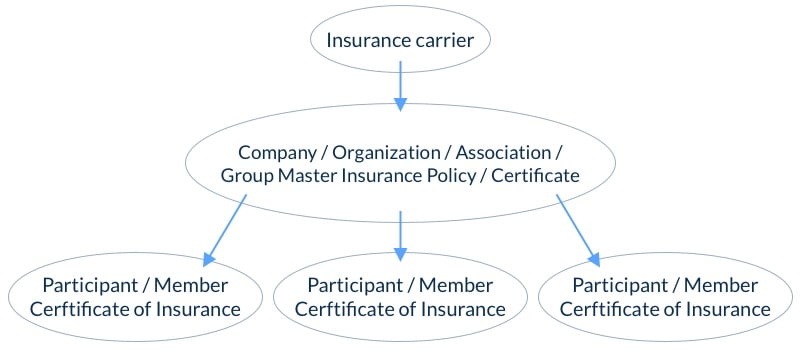
Example of Group Life Insurance

When Should You Get a Group Life Policy?

When coverage is offered for free

When group life coverage is offered as a free benefit - in this case, there is no reason to pass it up.

For inexpensive supplemental coverage

Group life insurance is a benefit and should not be the only life insurance coverage you have. It is recommended that you have individual life insurance, and a group life policy as additional coverage.

Since the risk of a claim is spread out among a large group, coverage costs are low for participants. Optional group coverage may or may not be a good financial decision. For those in good health, it is often cheaper to purchase an individual life insurance policy than to spend money on group coverage.

When you cannot qualify for individual life insurance

If you under 50 years of age and cannot qualify for individual life insurance, group coverage may be the only way to obtain life insurance.

Since there are few health questions that must be answered to qualify for group life coverage, this type of insurance is an option for people with health conditions such as:

  • Cancer
  • Schizophrenia
  • Immune disorders
  • Heart disease
  • Diabetes

How to Join a Group or Association

There are many types of groups and they all have different requirements for becoming a member.

Some charge membership fees or have participation requirements for its members.

Some associations that offer the best group life insurance:

Another way to find potential groups/associations is a google search for membership life insurance benefit

Access to groups and associations is a way to get access to insurance products and rates that are not possible for individuals.

Things to ask before becoming a member of a group

  • What are the requirements to become a member?
  • What are the requirements to stay a member?
  • Is the life insurance product portable?
  • Who is the carrier issuing the insurance products?
  • What is the financial rating of the insurance company?
  • Can I see an illustration of the policy that shows the guaranteed premiums and coverage?

Group Life Insurance Pros and Cons

What we like

More affordable than traditional policies

The risk to the insurance company is spread out among many participants in group plans. Group life insurance is often free for qualifying employees and group members.

It’s easy to qualify for group insurance

Group life plans have few health questions to qualify. Some plans have no health questions. The more coverage you apply for, the more health questions.

Fast approval

Applications are one or two pages, and they are active when the policy is processed by the insurance company. How fast this happens depends on the group and insurance company issuing the certificates. If you apply online, your policy may be active the moment you sign and date the application.

Full coverage from day 1

group policies do not have waiting periods for the full coverage amount to be available to beneficiaries. Some final expense whole life policies have a two-year waiting period for the full coverage amount is available.

There is no need for a medical exam

Medical exams cost insurance companies money. For small group life plans, the risk to insurance companies is small, so exams are not required. Typically the application is the only requirement to qualify.

There is no financial history check

When coverage amounts are small, insurance companies do not run financial risk assessments. Risk assessments cost the insurance company money are not required. As you increase your coverage amount, the insurance company may require this qualification requirement.

There are no height and weight requirements

Individual life insurance policies use build charts as one of the factors in determining the cost of a policy. Group life plans don’t have health classes so there is no need for height and weight requirements.

What we don’t like

It’s possible to lose the coverage if

  • You leave the company or group
  • The group drops the benefit
  • The company or group closes

You are not the owner of the policy

As with group life insurance offered through an employer, the association is the ultimate policyholder. The association holds the master policy, and issues certificates of insurance to its members. While a certificate of insurance is valid proof of having a life insurance policy, you are not the owner of the policy.

Premiums may increase

If the premiums aren’t guaranteed and the group experiences too many claims they can raise the premiums. Another way the premium could increase is if the plan offered is a “banded term policy in which the premiums increase every five years.

Coverage may decrease:

This happens when the premiums are guaranteed, but the coverage isn’t.  As you age, the risk to the insurance company increases. When you reach a certain age, typically 60 years old, the coverage amount begins to decrease every year.

Coverage is less compared to traditional policies

Group life is easier to qualify for than fully underwritten individual policies. Since there are so few health questions, the insurance company lowers its risk by offering low amounts of coverage.

Difficult to service

The insurance company does not handle general services like updating billing or beneficiary changes. Instead, service is often handled by the master certificate holder. This can cause confusion when the plan administrator is not a licensed insurance agent.

How Does Group Term Life Insurance Work?

Group term policies with 5 year coverage periods. Every five years the cost of the coverage increases.
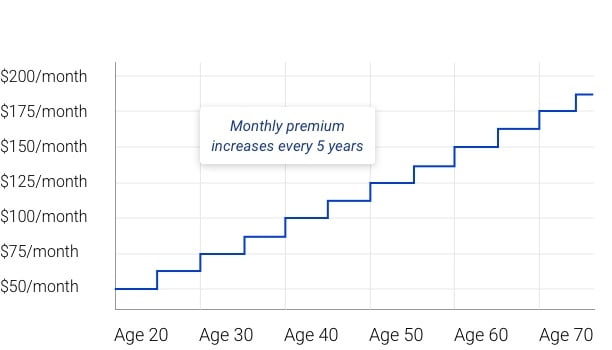
Group term life insurance explained

How Does Group Whole Life Insurance Work?

Group whole life policies with guaranteed level premiums where the coverage amount decreases after age 65.
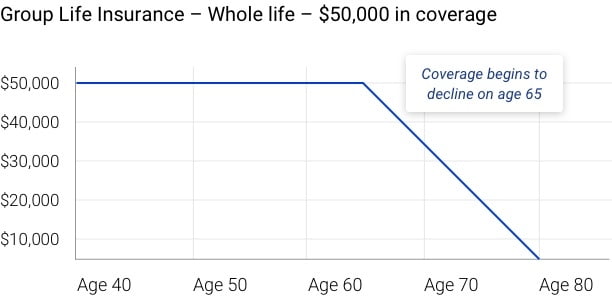
Group whole life insurance explained

Group Life Insurance Statistics

Group life insurance policies have been declining for the last decade

Depending on your personal situation, the pros can far outweigh the cons. Especially for individuals who would have a tough time qualifying for an individual life insurance policy, due to their health. Yet, group life insurance popularity has been declining for the last decade. Why?
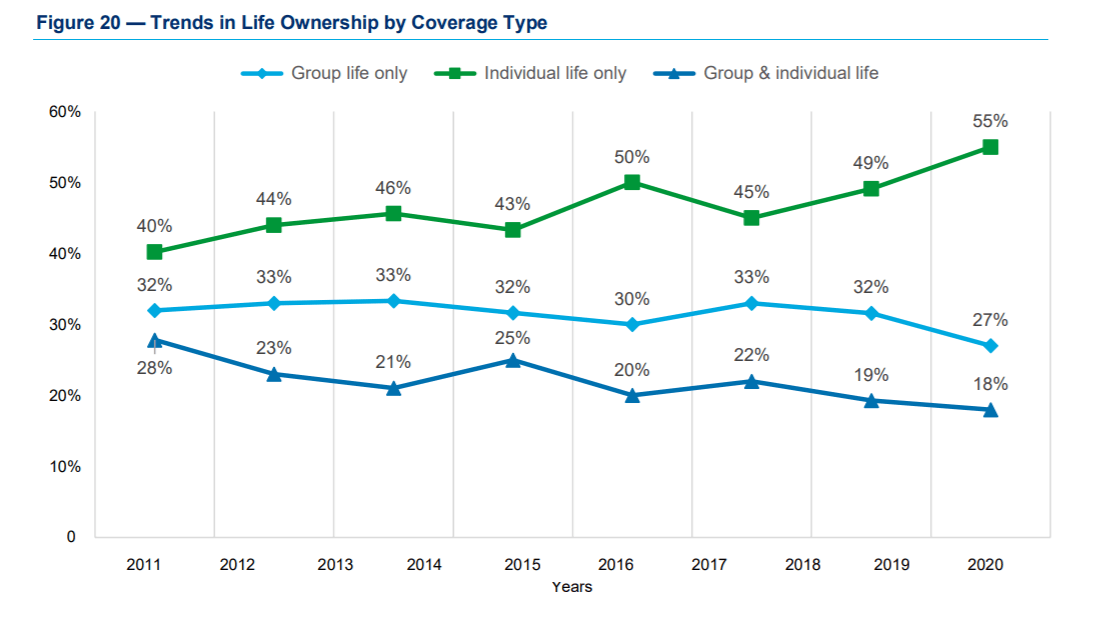
Barometer study on group life insurance vs individual life insurance
source: 2020 Limra Insurance Barometer Study

This could be largely due to the fact that fewer employers are offering group life insurance through work. Many individuals aren’t aware that they can join a group or association that offers this type of insurance on their own.

Of individuals who have life insurance in general, 55% of people have an individually owned life insurance policy, which is still the most popular choice by far. One in four individuals (27%) have group life insurance only.

Lastly, 18% of people who have life insurance, have both an individual and group owned policy.

Frequently Asked Questions

What is group life insurance, and how does it differ from individual life insurance?

Group life insurance is a type of life insurance coverage that is provided to a group of individuals, u
sually through an employer or membership organization. It differs from individual life insurance in that the policy is owned by the group or organization rather than the individual and typically provides lower coverage amounts at a lower cost per person.

Example: The American Association of Retired Persons (AARP) offers group life insurance to its members, with coverage amounts ranging from $10,000 to $100,000.

What types of groups offer life insurance to their members, and how do I know which one to choose?

Many different types of groups offer life insurance to their members, including professional associations, trade unions, fraternal organizations, and alumni associations. To choose the best group for you, consider the cost of membership, the level of coverage offered, and any additional benefits or perks provided by the group.

Example: The Freelancers Union offers life insurance to its members, as well as access to discounted dental and vision care, tax services, and legal advice.

Is there a minimum or maximum age limit for joining a group that offers life insurance?

Each group may have its own age limits for joining and participating in its life insurance program. Some groups may have a minimum age requirement of 18 or 21, while others may not have a maximum age limit.

Example: The National Association of Realtors offers group life insurance to its members with no maximum age limit, as long as the member is actively licensed and engaged in real estate activities.

What is the enrollment process for joining a group that offers life insurance?

The enrollment process may vary depending on the group or organization. Typically, you will need to complete an application and provide personal and demographic information, as well as pay any membership or signup fees required by the group.

Example: To join the Freelancers Union and enroll in its life insurance program, you would need to complete an online application, provide proof of freelance income, and pay a one-time $175 membership fee.

How much life insurance coverage can I get through a group plan, and how much will it cost?

The amount of life insurance coverage and cost of premiums will vary depending on the group and the individual policy. Some groups may offer a set amount of coverage for all members, while others may allow you to customize your coverage amount and premiums based on your individual needs and budget.

Example: The National Association of Social Workers offers group life insurance to its members with coverage amounts ranging from $10,000 to $1 million, with premiums based on age, gender, and smoking status.

Are there any medical exams or health screenings required to qualify for group life insurance?

Medical exams and health screenings may be required by some groups, particularly if you are applying for a higher level of coverage or if you have a pre-existing medical condition. However, many groups offer guaranteed issue coverage, which means you can qualify for coverage without any medical underwriting.

Example: The American Legion offers guaranteed issue group life insurance to its members with coverage amounts ranging from $1,000 to $5,000.

How long does it take to get approved for group life insurance coverage?

The approval process may vary depending on the group and the individual policy. Some groups may offer instant approval, while others may take several weeks to review your application and underwrite your policy.

Example: The National Association of Professional Women offers group life insurance to its members with instant approval and coverage starting as soon as the first premium payment is received.

Can I customize my group life insurance coverage to fit my specific needs?

Some groups may offer the ability to customize your coverage amount, premiums, and additional benefits based on your individual needs and budget. However, not all groups may offer this level of customization.

Example: The National Association of Home Builders offers group life insurance to its members with the ability to customize coverage amounts and premiums based on age, gender, and smoking status, as well as the option to add coverage for accidental death and dismemberment.

Are there any restrictions on when I can make changes to my group life insurance coverage?

Each group may have its own rules and restrictions regarding changes to coverage amounts, premiums, and additional benefits. Some groups may allow you to make changes at any time, while others may only allow changes during open enrollment periods.

Example: The American Dental Association offers group life insurance to its members with the ability to make changes to coverage amounts and premiums during open enrollment periods, which occur annually.

What other benefits besides life insurance does a group plan offer, and how do they compare to individual plans?

Many groups offer additional benefits and perks to their members, such as discounted medical services, access to wellness programs, and career development resources. These benefits may differ from individual plans in terms of cost and availability.

Example: The National Education Association offers group life insurance to its members, as well as access to discounted legal services, auto and home insurance, and travel discounts. These benefits are not typically available through individual plans.

Join a Group

Join an association that offers life insurance to members.

Frequently asked questions

What is group life insurance?+

Group life insurance is coverage where a group is the master policyholder and individual members receive certificates of insurance. It is most commonly offered by employers, but organizations, trade groups, and associations can also offer it. Term and whole life policies may be available depending on the group.

How is group life insurance different from individual life insurance?+

With group life insurance, the policy is owned by the group or organization rather than the individual member. It typically provides lower coverage amounts at a lower cost per person, and often has few health questions to qualify. Individual life insurance is owned by the individual and is often recommended alongside group coverage.

When should you get a group life policy?+

Getting group life coverage makes sense when it is offered for free, since there is no reason to pass it up. It can also work as inexpensive supplemental coverage in addition to individual life insurance. If you cannot qualify for individual life insurance, group coverage may be the only way to obtain life insurance.

Can I get group life insurance if I have health conditions?+

Group life insurance can be an option because there are few health questions, and some plans have no health questions. It may help people with conditions such as cancer, schizophrenia, immune disorders, heart disease, and diabetes. In the situations described, this can be especially useful for individuals under age 50 who cannot qualify for individual coverage.

How do you join a group or association for life insurance?+

Groups and associations have different membership requirements, and some charge membership fees or require participation. Examples of groups listed include Freelancers Union, AARP, Costco Insurance Marketplace, Writers Guild of America West, and others. A search for membership life insurance benefit can help identify potential groups that offer coverage.

What questions should I ask before joining a group for life insurance?+

Key questions include what is required to become and stay a member, and whether the life insurance is portable. It also helps to ask who the carrier is, what the insurer's financial rating is, and whether you can see an illustration showing guaranteed premiums and coverage. These details can clarify long term costs and how the plan works.

What are the main pros and cons of group life insurance?+

Pros include affordability, easy qualification with few or no health questions, fast approval, no medical exam, and no financial history check for small coverage amounts. Cons include potentially losing coverage if you leave the group or the group ends the benefit, and not being the policy owner. Premiums may increase and coverage may decrease with age depending on plan design.

How do group term and group whole life insurance work?+

Group term life policies can have 5 year coverage periods, and the cost can increase every five years. Group whole life policies can have guaranteed level premiums, with the coverage amount decreasing after age 65. Some plans may also reduce coverage starting around age 60 in certain designs where coverage is not guaranteed.

About the authors

Brian Greenberg

Written by

Brian GreenbergCEO / Founder & Licensed Insurance Agent

Brian is the founder and CEO of Insurancy and carries Life, Health, and Property & Casualty licenses in all 50 U.S. states. Since 2013, Brian has been a member of Million Dollar Round Table, a designation for the top 1% of financial advisors worldwide. Brian has been featured in Yahoo! Finance, Money.com, Entrepreneur.com, Life Happens, Forbes, MSN, and Good Financial Cents. Brian’s goal is to show customers the best products, the quickest answers to their questions, and provide expert advice.

Lisa A Koosis

Reviewed by

Lisa A KoosisMedical Claims Specialist

Lisa worked as a medical claims specialist for five years, adjudicating claims, developing appeals training programs and liaising with insurance auditors. As a full-time freelancer, she now completes work that includes writing and fact-checking life and health insurance content for a variety of online publications.

30-second quiz

Find your best life insurance type

Answer a few quick questions and get matched with the right kind of policy.

Take the quiz

Full assessment

Get your complete coverage plan

How much coverage you need, which type fits, and what you should pay.

Start the assessment

Keep reading

Related articles

Accidental Death InsuranceLife Insurance

Accidental Death Insurance

Accidental death and dismemberment (AD&D) insurance is a supplemental policy that pays a tax-free lump sum if the insured dies in a covered accident or suffers a specified dismemberment. Premiums are low because the insured event is statistically rare, and underwriting is fast because there is no medical exam.

Brian GreenbergUpdated Jun 2026

Affordable Life Insurance: How to Find the Cheapest CoverageLife Insurance

Affordable Life Insurance: How to Find the Cheapest Coverage

Affordable life insurance is the result of three buyer choices: the cheapest product type (term life), the lowest-rate carrier for your specific health profile, and an underwriting class that matches your actual health. This guide shows sample rates from the cheapest A-rated carriers, the 7 levers that move buyers into the lowest rate class, and the trade-offs between paying $11 a month versus $30 a month for the exact same coverage.

Brian GreenbergUpdated Jun 2026

Are Life Insurance Premiums Tax Deductible?Life Insurance

Are Life Insurance Premiums Tax Deductible?

For personal life insurance policies, premiums are not federal-tax-deductible. The exceptions are narrow but specific: business-owned life insurance used as a documented compensation tool, alimony-required policies issued under pre-2019 divorce decrees, premiums paid by a 501c3 charity that owns the policy, and group life insurance up to $50,000 per employee under IRC Section 79. This guide walks through each exception, the IRS rules that govern it, and how to structure the policy correctly so the deduction is defensible on audit.

Brian GreenbergUpdated Jun 2026

Get the most accurate rates in 2 minutes or less

Making a financial decision doesn’t have to be stressful. See what you qualify for by answering some health questions.

Get a Free Quote